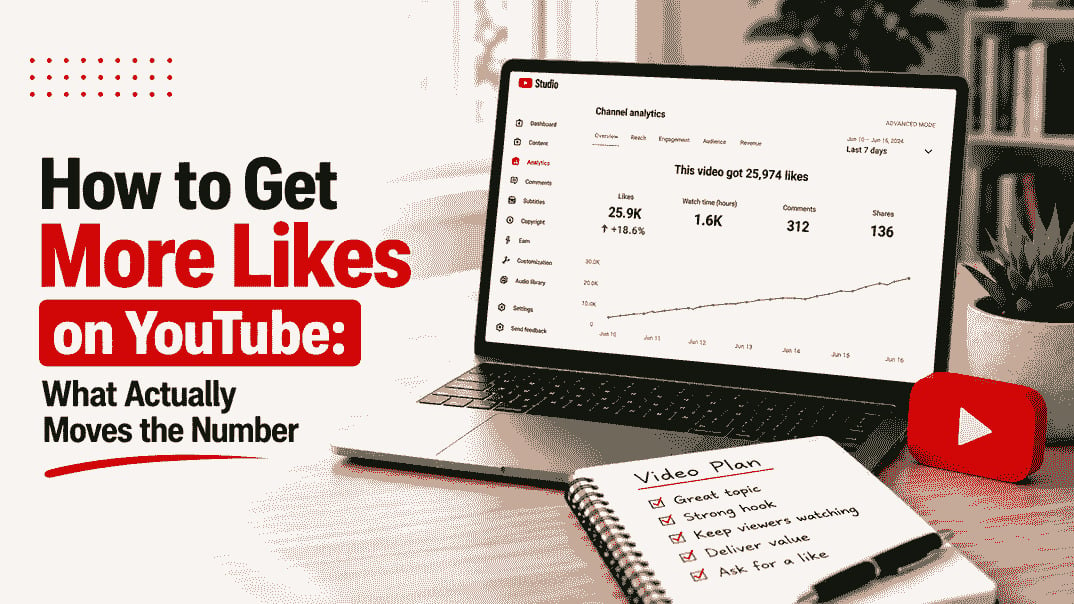



More likes come from giving the right viewers a reason to care, not simply asking them to click Like. If you are looking for how to get more likes on YouTube, you might be tired of generic advice like 'just ask for them.' In practice, building genuine engagement rarely works that way.
After working with SEO and social content, I’ve found that the videos that consistently attract engagement have something in common: they give the right audience a clear reason to keep watching and respond.
YouTube’s own explanation of its recommendation system supports this broader view. The platform looks at how viewers respond to content across three areas: appeal, engagement, and satisfaction. In other words, did people choose the video, did they keep watching, and did they enjoy it?
Likes are part of that bigger picture. They matter, but chasing the Like button by itself is not a YouTube growth strategy.
Here’s what actually moves the number.
What Influences Viewers to Like Your Videos and How to Get More Likes on YouTube?
A viewer usually presses Like because the video gave them something worth acknowledging.
That might be a solution to a problem, an entertaining experience, a useful discovery, a strong opinion, an emotional reaction, or simply a video that delivered exactly what the viewer expected.
I think about it this way:
Right viewer + relevant topic + satisfying experience = higher likelihood of a Like
This is why audience targeting matters so much. A video can have excellent production quality and still receive few likes if it reaches people who have little interest in the subject.
YouTube says its recommendations are driven by what viewers watch and enjoy, using signals that include viewing behavior, search history, subscriptions, likes, dislikes, comments, shares, feedback and satisfaction surveys.
So instead of asking, "How do I make people Like my video?", I recommend asking:
"How do I make the right viewer feel that this video was worth their time?"
That question leads to better content.
How YouTube Likes Fit Into the Algorithm
There is a lot of misleading advice online about YouTube likes.
You will find claims that likes are the most important ranking factor or that reaching a particular like-to-view percentage automatically triggers more recommendations. I would not build a strategy around either claim.
YouTube says its recommendation system uses many signals, and the specific signals can vary depending on the YouTube feature and context. Likes are one signal that helps the system understand viewer preferences, but they are not the entire recommendation system.
YouTube currently describes content performance through three broad questions:
- Appeal: Did viewers choose to watch?
- Engagement: Did they continue watching?
- Satisfaction: Did they enjoy the content?
That gives creators a much more useful framework.
A compelling thumbnail can improve the chance of a click. A strong opening can help keep the viewer watching. Useful or entertaining content can create satisfaction. A viewer who genuinely enjoyed the experience is then more likely to interact with it, including leaving a Like.
The Like is often the result of a good viewing experience, not the thing that creates one.
Read more: How to Get Recommended on YouTube - Proven Strategies
1. Create Videos for a Specific Audience
If your video is designed for everyone, it may feel relevant to almost nobody.
Before creating a video, I recommend defining the viewer as specifically as possible.
Ask:
- Who is this video for?
- What problem are they trying to solve?
- What do they already know?
- What would make them stop scrolling?
- What would make them recommend this video to someone else?
For example, "How to Improve Your YouTube Channel" is broad.
"How to Get Your First 1,000 YouTube Subscribers as a Small Creator" speaks to a much clearer audience.
The second topic gives you a better foundation for the title, thumbnail, opening, examples and call to action.
YouTube itself recommends identifying your core and potential audience when developing content and focusing on what that audience actually enjoys.
When the right people find your video, you don't have to work as hard to convince them that it is worth liking.
2. Choose Topics People Already Want to Watch
Great execution cannot always rescue a topic nobody wants.
YouTube points to topic interest, competition and changes in viewer behavior as external factors that can influence how many people see a video. A subject with naturally broader interest can have a larger potential audience, while highly competitive topics require stronger content and packaging to stand out.
Before producing a video, I would check:
- YouTube search suggestions
- Questions viewers ask in comments
- Your previous high-performing videos
- Competitor channels
- YouTube Analytics
- Trending topics within your niche
- Related searches and recurring audience problems
The goal isn't to copy another creator.
It is to discover existing demand and then give that demand a better answer.
More relevant viewers also mean more people who have a genuine reason to engage with your content.
Read more: Why Are My YouTube Views Not Increasing?
3. Fix the First Few Seconds to Get More Likes on Your YouTube Videos
One of the biggest mistakes I see is spending too much time getting to the point.
"Hey guys, welcome back to my channel. Today we're going to talk about..."
The viewer may already be gone.
YouTube says the opening seconds are especially important because viewers decide whether to stay or move on. It recommends making the introduction concise and ensuring it delivers on the promise made by the title and thumbnail.
A stronger opening could be:
"If your videos get views but barely any likes, these are the three things I would change first."
Now the viewer knows exactly why they should continue.
Your hook should quickly establish relevance, create curiosity or deliver value. Don't make viewers wait for the reason they clicked.
Better retention means more people actually reach the part of the video where your strongest information, entertainment or payoff happens.
Read more: Best and Most Effective Ways to Increase Watch Time on YouTube
4. Give Viewers a Reason to Like Your YouTube Videos
Yes, you should ask for likes.
But when and how you ask matters.
A generic "Don't forget to like and subscribe!" can easily become background noise.
Instead, connect the CTA to the value you just provided.
For an educational video:
"If this tutorial saved you some time, hit Like so I know to make more guides like this."
For a review:
"If this comparison helped you decide which option is right for you, a Like helps me know these comparisons are useful."
For entertainment:
"If that ending caught you off guard, you know what to do."
I prefer this approach because the request has context. You aren't asking viewers to perform a favor before they've received anything.
The best CTA feels like the natural next step after a satisfying moment.
5. Make Your Title and Thumbnail Earn the Click
Titles and thumbnails don't directly create Likes.
They create the opportunity to earn them.
YouTube describes packaging as an important part of content performance and specifically identifies titles and thumbnails as ways to communicate value, create intrigue and establish viewer expectations.
Consider the difference:
How to Get More YouTube Likes
versus:
Why Your YouTube Videos Get Views but No Likes
The second creates a specific problem and promises an explanation.
But there is an important rule: your video needs to deliver what the packaging promises.
A clickbait title can generate clicks, but if the viewer immediately realizes the video isn't what they expected, engagement and satisfaction can suffer.
I always think of the title and thumbnail as a promise.
The video has to keep that promise.
6. Turn Viewers Into Participants
A Like is only one form of YouTube engagement.
Comments, shares, subscriptions and continued viewing can all tell you something about how your audience responds to your content.
Give viewers a reason to participate.
Instead of ending with:
"Any thoughts?"
Ask something specific:
"Which YouTube metric do you find hardest to improve: views, retention or subscribers?"
Or:
"Would you choose option A or B? Tell me why in the comments."
You can also:
- Respond to early comments
- Pin useful or interesting comments
- Turn recurring questions into future videos
- Use Community posts to continue conversations
- Create follow-up content based on viewer feedback
This creates a stronger relationship between the creator and audience rather than treating every viewer as a number.
Read more: How to Get Your First 1,000 Subscribers on YouTube
7. Use YouTube Analytics to Find Your Like-Winning Content
This is where I would stop guessing and start looking at your own data.
YouTube Studio gives creators access to YouTube Analytics, where they can review metrics including views, likes, comments, shares, watch time and audience retention.Its Content and Analytics reports can also help you compare videos and identify patterns.
Look at your best-performing videos and ask:
- Which topics receive the most Likes?
- Which videos have the strongest retention?
- Which videos attract the most comments?
- Which formats perform best?
- Where do viewers drop off?
- Which videos bring returning viewers?
- Do certain topics consistently outperform others?
I particularly like comparing videos with similar view counts.
Suppose Video A receives 200 likes from 10,000 views while Video B receives 600 likes from the same number of views.
That's a useful signal.
Now investigate what was different.
Maybe Video B had a stronger emotional payoff. Maybe the topic was more relevant. Perhaps the CTA was better timed or the audience was more targeted.
That is far more useful than copying somebody else's "secret YouTube strategy."
8. Use Shorts for Discovery, Not as a Guaranteed Like Hack
YouTube Shorts can be useful for reaching new viewers, but I would not assume that making Shorts automatically means getting more Likes.
YouTube says its recommendation system operates across Shorts, long-form videos, live streams and posts, while also acknowledging that viewers can have different preferences across formats. Someone who enjoys your Shorts may not automatically watch your long-form content.
Use Shorts strategically.
A Short can:
- Introduce your topic
- Demonstrate your expertise
- Create curiosity around a longer video
- Reach viewers who haven't discovered your channel
- Test ideas before investing in a longer production
Think of Shorts as another entry point into your content ecosystem rather than a guaranteed engagement shortcut.
Can You Buy YouTube Likes?
You can find services offering YouTube likes, but there is an important distinction between increasing a visible number and creating genuine audience engagement.
If real viewers aren't interested in your content, adding Likes doesn't solve the underlying problem.
My approach is to build the audience first and treat Likes as one of the outcomes you measure.
If you use any third-party promotion service, you should also consider whether the activity aligns with YouTube's policies and whether the resulting audience is actually relevant to your channel.
A video with fewer Likes from genuinely interested viewers is more valuable to me than an impressive-looking number that tells me nothing about audience satisfaction.
How Many Likes Is Good on YouTube?
There isn't one universal number that makes a YouTube video successful.
Ten Likes from 200 views tells a different story from 1,000 Likes from 100,000 views.
One simple metric you can calculate is the like-to-view rate:
Likes ÷ Views × 100 = Like-to-view rate
For example:
500 Likes ÷ 10,000 views × 100 = 5%
Some third-party YouTube guides use figures such as 4% to 5% as informal benchmarks, but I would not present those numbers as official YouTube targets. YouTube does not publish a universal Like-to-view percentage that guarantees better recommendations.
Your own historical data is more useful.
Compare similar videos on your channel and look for trends over time.
Why Do My YouTube Videos Get Views but Few Likes?
This is actually a useful problem to diagnose.
Your videos may be getting more views without many Likes because:
The audience isn't a strong match.
Your title may attract viewers who aren't genuinely interested in your broader content.
The video answers the question but creates little connection.
This can happen with search-based tutorials. A viewer gets the information and leaves.
The opening loses people.
If the strongest value comes too late, viewers may never reach it.
The CTA feels forced.
Repeatedly asking for engagement can feel transactional.
The content isn't memorable.
Useful information is good. Useful information presented through storytelling, examples, personality or a clear point of view can be more engaging.
The title or thumbnail sets the wrong expectation.
A mismatch between the packaging and the actual video can damage viewer satisfaction.
Use YouTube Analytics to determine which problem you're actually dealing with instead of changing everything at once. YouTube's retention reports can show where viewers lose interest, while engagement reports show how they interact with the content.
A Quick Case Study: Shifting the Focus
I recently audited the engagement data for a mid-sized tech tutorial channel that had been struggling with stagnant metrics, averaging just 100 likes per 10,000 views.
To address this, we implemented a structured testing approach. Instead of generic, broadcast-style "please like" requests, we aligned the call-to-action (CTA) with the specific point of value in each video.
We used YouTube Studio’s engagement reports to pinpoint exactly when viewers experienced the "aha" moment, he specific second where the core problem was solved, and placed the CTA immediately following it with a value-based prompt, such as: "If this fix saved you an hour of troubleshooting, hit Like so others can find the solution faster."
After tracking these changes across their top 10 videos over a three-month period, we observed a consistent 15% increase in like-to-view rates.
This result underscores a key pillar of YouTube growth: viewers are significantly more likely to engage when the request acknowledges the tangible benefit they just received, proving that strategic placement and data-backed timing often outperform generic repetition.
Proven, Free Ways to Get More Likes on YouTube
If you don't have a promotional budget, start with the things you control.
- Create videos around real audience demand.
- Improve the first few seconds.
- Make titles and thumbnails clearer.
- Deliver the promised value quickly.
- Ask for Likes after a useful or entertaining moment.
- Ask specific questions in your videos.
- Respond to comments.
- Repurpose successful ideas into Shorts.
- Study your highest-engagement videos.
- Create more of the formats your audience already responds to.
None of these requires buying engagement.
More importantly, they improve the underlying experience that makes genuine engagement possible.
Final Take
If you want more Likes on YouTube, don't make the Like button your main objective.
Make the viewer your objective.
Find a topic they care about. Package it clearly. Give them a reason to click. Deliver the promised value quickly. Keep the experience engaging. Then give them an easy, natural opportunity to respond.
YouTube's own recommendation guidance ultimately points creators in the same direction: focus less on trying to "please the algorithm" and more on understanding what your audience wants to watch and enjoys.
That's what actually moves the number.
Frequently Asked Questions
How do I get more likes on YouTube?
Create content for a clearly defined audience, choose topics people care about, improve your opening, deliver value throughout the video and ask for a Like at a natural moment. Then use YouTube Analytics to identify which topics and formats generate the strongest engagement on your channel.
How can I increase YouTube likes for free?
Focus on organic audience growth. Improve your titles and thumbnails, create stronger hooks, answer specific audience questions, engage with comments, promote relevant videos through your existing social channels and repeat topics that have already performed well.
How do I get 1,000 likes on YouTube?
There is no guaranteed method for reaching 1,000 Likes. You need enough relevant viewers and a video that gives those viewers a reason to engage. Increasing reach through strong topics, packaging and viewer satisfaction is a more sustainable strategy than focusing on the Like count alone.
Does liking a YouTube video help it get more views?
Likes are one of the signals YouTube uses to understand viewer preferences and content performance, but they are not the only factor behind recommendations. YouTube also considers viewing behavior, personalization, engagement and satisfaction, among other signals.
What is a good like-to-view ratio on YouTube?
There is no official YouTube ratio that applies to every channel. Calculate your Likes divided by views, then compare similar videos on your own channel. This gives you a more useful baseline than treating an unofficial percentage as a universal target.
Why do my YouTube videos get views but no likes?
Views do not necessarily mean that viewers felt strongly enough about the content to engage. The audience may have found the video through search, received the information they needed and left. Weak audience fit, poor retention, an ineffective CTA or limited emotional connection can also contribute.
Should I ask viewers to like my YouTube video?
Yes, but timing matters. I recommend asking after you have already delivered something useful, entertaining or interesting. A contextual CTA generally feels more natural than asking viewers to Like the video before they have received any value.
Do YouTube Shorts get more likes?
Not necessarily. Shorts can provide additional discovery, but engagement varies by audience, topic and format. YouTube notes that viewers can have different preferences for Shorts and long-form videos, so Shorts should be evaluated on their own performance rather than assumed to generate more Likes.
Does watch time matter more than likes on YouTube?
It is better not to think of YouTube as having one single "most important" metric. YouTube describes content performance through appeal, engagement and satisfaction, while its recommendation system uses many signals. Watch time and audience retention can therefore provide important context alongside Likes and other engagement metrics.
Do thumbnails help you get more YouTube likes?
Indirectly, yes. A strong thumbnail can help the right viewer decide to click. The resulting viewing experience then determines whether that viewer stays, enjoys the content and engages. YouTube identifies titles and thumbnails as important parts of content packaging and viewer appeal.
How do I use YouTube Analytics to get more likes?
Compare your videos by topic, format, views, Likes, comments, audience retention and other engagement metrics. Look for recurring patterns among your strongest videos. YouTube Analytics also lets creators examine audience retention and compare content performance to make more informed decisions about future videos.
Is buying YouTube likes a good way to grow a channel?
I wouldn't use purchased Likes as the foundation of a growth strategy. A larger number does not automatically mean you have a stronger audience. I would prioritize relevant viewers, valuable content and genuine engagement because those are the things that build a channel beyond a single visible metric.