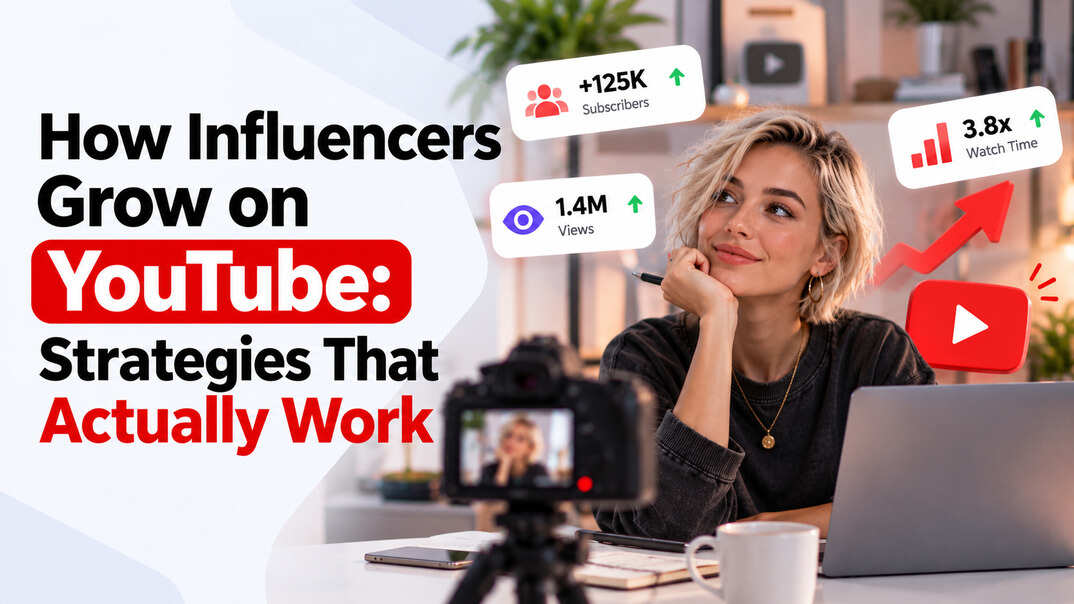



How do influencers grow on YouTube? They find the right audience, create content people want to watch, and keep improving what works.
Growing a YouTube channel isn't about discovering one secret algorithm hack. The creators who consistently build an audience usually follow a repeatable process: they choose strong topics, package them well, keep viewers engaged, analyze their results, and use those insights to make better videos.
YouTube describes recommendation performance around three core areas: appeal, engagement, and satisfaction. In practical terms, creators need to get people interested enough to click, give them a reason to keep watching, and deliver what the video promised.
How Do Influencers Grow on YouTube?
Influencers grow on YouTube by combining a clear niche with audience-focused content, strong titles and thumbnails, YouTube SEO, audience retention, consistent publishing, collaborations, and analytics to get more views.
The strategies work together.
A great video won't go far if nobody wants to click it. A high click-through rate won't help much if viewers leave immediately. And a video that performs well once doesn't automatically create sustainable channel growth.
I think of YouTube growth as a simple cycle:
Find the right topic → package it well → earn the click → deliver value → study the results → improve the next video.
The creators who repeat that cycle effectively are the ones who tend to build lasting audiences.
1. Influencers Start With a Clear Audience
Successful YouTubers usually know who they want to reach.
A beauty creator might focus on affordable makeup for women over 30. A gaming creator might specialize in a particular game. A finance channel might focus on investing for beginners rather than covering every possible financial topic.
That doesn't mean a channel can never evolve. It means viewers should quickly understand what the channel offers and why they should subscribe.
YouTube also recommends building a substantial library of high-quality content around a clear area of expertise or interest. This gives new viewers more opportunities to explore a channel after discovering one video.
From an SEO perspective, a clear audience also makes content research much easier. You can identify specific questions, problems and search terms instead of trying to rank for everything.
2. They Choose Topics People Actually Want to Watch
One of the biggest content mistakes is starting with:
What do I want to publish?
A better question is:
What does my audience want to watch?
Influencers can find ideas through:
-
YouTube search suggestions
-
Google Search
-
YouTube Analytics
-
Competitor channels
-
Reddit discussions
-
Audience comments
-
Trending topics
-
Frequently asked questions
The goal isn't to copy another creator. It's to identify an existing audience interest and approach it with a better angle, stronger expertise or more useful information.
For example:
Generic:
“10 YouTube Tips for Beginners”
More specific:
“Why Your First 1,000 YouTube Subscribers Take So Long”
The second topic addresses a recognizable problem and gives the viewer a clear reason to click.
3. They Use YouTube SEO Without Making Videos Feel Like SEO
YouTube SEO can help people discover relevant content, but I wouldn't build a channel around keyword stuffing.
Start with search intent.
What is the person actually trying to find? What question are they trying to answer? What would make them feel that the video completely solved their problem?
Use the primary topic naturally in:
-
Video titles
-
Spoken content
-
Descriptions
-
Chapters
-
Relevant supporting text
YouTube says titles, thumbnails and descriptions are important metadata, while tags play a minimal role and are primarily useful for common spelling mistakes.
In other words, I would spend much more time on the topic, angle, title, thumbnail and actual video than obsessing over tags.
Read more: How to Get Recommended on YouTube - Proven Strategies
4. They Treat the Title and Thumbnail as One Package
A good video needs good packaging.
The title and thumbnail should work together to answer two questions:
What is this about?
Why should I care?
For example:
Weak:
“How to Grow Your YouTube Channel”
Stronger:
“Why Your YouTube Videos Get Views but No Subscribers”
The second version creates a specific expectation and speaks directly to a problem.
YouTube recommends thumbnails and titles that accurately represent the content and warns against misleading or sensational packaging.
Curiosity is useful. Deception isn't.
5. They Get to the Point Quickly
Once someone clicks, the next challenge begins.
The opening seconds need to justify the click.
I wouldn't spend the first 30 seconds on a long introduction, channel history or generic greeting. If someone searched for how to grow on YouTube, give them a reason to stay before asking them to like and subscribe.
A strong opening can:
-
Establish the problem
-
Promise a useful outcome
-
Show the result
-
Ask a compelling question
-
Introduce an unexpected insight
YouTube's guidance emphasizes creating engaging hooks and making sure the opening delivers on the promise made by the title and thumbnail.
6. They Optimize for Audience Retention
A view is only the beginning.
I want to know what happened after the click.
Did viewers stay? Where did they leave? Was there a major drop during the introduction? Which parts kept their attention?
YouTube Analytics provides audience-retention data that helps creators understand where viewers continue watching and where they lose interest.
This turns content strategy into something measurable, helping creators increase subscribers base over time.
Instead of saying:
“I think people liked this video.”
You can ask:
“What did viewers actually do?”
That distinction is extremely useful when deciding what to publish next.
7. They Don't Obsess Over an “Ideal” Video Length
There is no magic YouTube video length.
YouTube explicitly says there is no universal ideal video length. The right length depends on the content, audience and purpose.
If a tutorial needs 15 minutes to explain something properly, make it 15 minutes.
If the same information can be delivered effectively in six minutes, don't stretch it to 15.
The goal isn't to make a video longer.
The goal is to make it worth watching.
8. They Use YouTube Shorts for Discovery
YouTube Shorts give creators another way to reach potential viewers.
A creator can turn one long-form topic into several short-form ideas.
For example:
Long-form:
“How I Grew My YouTube Channel From 0 to 10,000 Subscribers”
Shorts:
-
“The biggest mistake I made at 100 subscribers”
-
“Why your YouTube videos aren't getting views”
-
“3 things I stopped doing on YouTube”
-
“The thumbnail mistake hurting your CTR”
This creates additional entry points into the channel.
However, I wouldn't assume that every Shorts viewer will automatically become a long-form viewer. Different viewers have different preferences for Shorts, long-form videos, live streams and other formats.
Use the format that makes sense for the idea, then measure the response.
Read more: How Much Does YouTube Shorts Pay for 1,000 Views?
9. They Turn Winning Topics Into Content Series
This is one of the easiest ways to build momentum.
If one video performs significantly better than your average, don't immediately move to a completely unrelated topic.
Ask what made it work.
Was it:
-
The subject?
-
The audience?
-
The format?
-
The problem it solved?
-
The timing?
-
The title?
-
The thumbnail?
-
The creator's personal experience?
Then explore the same audience interest from another angle.
For example:
Video 1: How to Get Your First 1,000 YouTube Subscribers
Video 2: Why YouTube Channels Get Stuck at 1,000 Subscribers
Video 3: What I Would Do Differently to Reach 1,000 Subscribers
Video 4: How Long Does It Really Take to Get 1,000 YouTube Subscribers?
That's not repetitive content. It's a content cluster around a proven audience interest.
10. They Collaborate With Creators and Brands
Collaboration can introduce a creator to an audience that already cares about the subject.
But bigger isn't always better.
I'd rather see a creator collaborate with someone who has a highly relevant audience than partner with a huge creator whose viewers have nothing to do with their niche.
Creator collaborations can include:
-
Interviews
-
Guest appearances
-
Joint videos
-
Podcasts
-
Challenges
-
Tutorials
-
Expert discussions
-
Live streams
Brand partnerships can create another growth opportunity. A sponsored tutorial, product review or educational video can expose a creator to a brand's audience while generating revenue.
The important part is relevance.
A partnership should make sense for the creator's audience and fit naturally into the channel.
11. They Build Relationships With Their Audience
Subscribers aren't just numbers.
The strongest YouTube channels create communities that want to hear from the creator again.
Creators can strengthen that relationship through:
-
Responding to comments
-
Community posts
-
Polls
-
Viewer questions
-
Live streams
-
Behind-the-scenes content
-
Follow-up videos
-
Audience suggestions
I particularly like using comments as a source of content ideas.
When viewers repeatedly ask the same question, they're essentially telling you what they want to see next.
Read more: How to Get More Likes on YouTube: What Actually Moves the Number
12. They Use YouTube Analytics to Make Better Decisions
This is where YouTube growth becomes a process rather than guesswork.
In YouTube Studio, creators can examine metrics such as:
-
Impressions
-
Click-through rate
-
Views
-
Watch time
-
Audience retention
-
Average view duration
-
Traffic sources
-
Subscribers gained
-
Returning viewers
-
Unique viewers
But don't look at one number in isolation.
For example, YouTube explains that CTR needs to be interpreted in context. It can decline as a video reaches a broader audience because the content is being shown to people beyond its core audience.
So if CTR falls while impressions increase significantly, I wouldn't automatically call the video a failure.
I'd ask:
Is the video reaching more people? Are those viewers watching? Are they satisfied?
Context matters.
Read more: Why Are My YouTube Views Not Increasing?
13. They Measure More Than Subscriber Growth
For an influencer, channel growth and business performance aren't necessarily the same thing.
I'd separate the metrics into two groups.
Channel growth metrics
-
Views
-
Watch time
-
Subscribers
-
Returning viewers
-
Audience retention
-
Click-through rate
-
Traffic sources
Influencer marketing metrics
-
Sponsored video views
-
Engagement
-
Link clicks
-
Conversions
-
Audience reach
-
Brand mentions
-
Campaign-specific results
This distinction becomes especially important as a creator starts working with brands.
A creator with 30,000 highly engaged subscribers in a specific niche can sometimes be more valuable to a relevant brand than a much larger channel with little audience overlap.
How Influencer Marketing Can Help YouTube Creators Grow
Influencer marketing isn't only something brands use to reach creators. It can also become part of a creator's growth strategy.
A YouTuber can grow through:
-
Creator-to-creator collaborations
-
Sponsored videos
-
Product reviews
-
Expert interviews
-
Brand partnerships
-
Cross-platform promotion
-
Affiliate content
-
Co-created campaigns
The best partnerships don't feel like interruptions to the channel; when people like your content, sponsored elements fit naturally into what the audience already expects.
For example, a technology creator reviewing a new laptop has a much more natural brand fit than a creator suddenly promoting an unrelated product.
That relevance matters for both audience trust and long-term influencer marketing opportunities.
How Long Does It Take to Grow on YouTube?
There is no reliable timeline.
Some channels gain traction quickly after finding the right topic. Others spend months or years building a loyal audience.
I would be skeptical of anyone promising a guaranteed number of subscribers within a specific number of days.
Growth depends on factors including:
-
Niche
-
Competition
-
Content quality
-
Audience demand
-
Consistency
-
Distribution
-
Viewer response
-
Creator experience
More importantly, subscriber growth isn't the only thing worth measuring.
A smaller channel with highly engaged returning viewers can be healthier than a larger channel whose subscribers rarely watch.
Do You Need Millions of Views to Become a YouTube Influencer?
No.
Being an influencer isn't necessarily about having millions of subscribers.
A creator with a smaller but highly relevant audience can have significant influence within a particular niche.
Imagine a photography channel with 30,000 engaged subscribers. If those viewers are serious photographers, the channel could be highly valuable to a camera brand even though it isn't one of YouTube's biggest channels.
That's why I recommend thinking about audience relevance, engagement and trust, not just subscriber count.
Final Take
So, how do influencers grow on YouTube?
They don't rely on one secret algorithm trick.
They understand their audience, find topics worth watching, create strong titles and thumbnails, deliver value quickly, keep viewers engaged, analyze their data and repeat what works.
The most useful mindset shift is simple:
Don't try to make the algorithm like your video. Make the right viewers want to watch it.
When you consistently create content that people choose, watch and enjoy, you give YouTube stronger reasons to recommend it to relevant viewers.
And when a video performs well, don't treat it as a lucky accident.
Study it.
Find out why it worked.
Then make the next one better.
Frequently Asked Questions
How do influencers grow on YouTube?
Influencers grow by combining a clear niche, relevant content ideas, strong titles and thumbnails, engaging videos, audience interaction, collaborations and regular performance analysis. Successful creators continually learn from their audience and improve their content.
How do influencers get their first 1,000 YouTube subscribers?
Creators can reach their first 1,000 subscribers by targeting a specific audience, creating useful or entertaining content, optimizing videos for discovery, promoting their channel and building relationships with viewers. There is no guaranteed formula or timeline.
How long does it take to grow on YouTube?
There is no standard timeline. Some channels gain traction quickly, while others take months or years to build a substantial audience. Niche, competition, content quality, audience demand and viewer response all influence growth.
How often should influencers post on YouTube?
There is no universal posting frequency that guarantees growth. A sustainable schedule that allows you to consistently produce useful content is generally better than publishing frequently at the expense of quality.
Does YouTube SEO help influencers grow?
Yes. YouTube SEO can help relevant viewers discover videos through search. However, SEO alone doesn't guarantee growth. The video also needs a strong topic, compelling packaging and content that satisfies the viewer's intent.
Do YouTube Shorts help channels grow?
Shorts can help creators reach new viewers and experiment with short-form content. However, Shorts viewers and long-form viewers don't always behave the same way, so creators should analyze how each format performs for their audience.
What makes a YouTube video go viral?
There is no guaranteed formula. Strong topics, timing, packaging, audience interest and viewer response can combine to produce rapid growth. Virality is usually the result of several factors working together rather than one trick.
How important are YouTube thumbnails?
Very important. Thumbnails help viewers understand what a video offers and can influence whether they click. They should accurately represent the video rather than use misleading claims.
Does video length affect YouTube rankings?
There is no universal ideal video length. The appropriate length depends on the topic, audience and purpose. Creators should use audience-retention data to understand what works for their viewers.
Should YouTubers focus on subscribers or views?
Both can be useful, but neither tells the entire story. Returning viewers, watch time, audience retention, engagement and traffic sources can provide a much better picture of channel health.
Can collaborations help a YouTube channel grow?
Yes. Collaborations can expose creators to relevant new audiences. The strongest partnerships usually involve creators whose audiences share similar or complementary interests.
Can influencer marketing help YouTubers grow?
Yes. Creator collaborations, brand partnerships, sponsored content and cross-promotion can increase exposure and create new audience and revenue opportunities. The partnership should remain relevant to the creator's audience to protect trust.