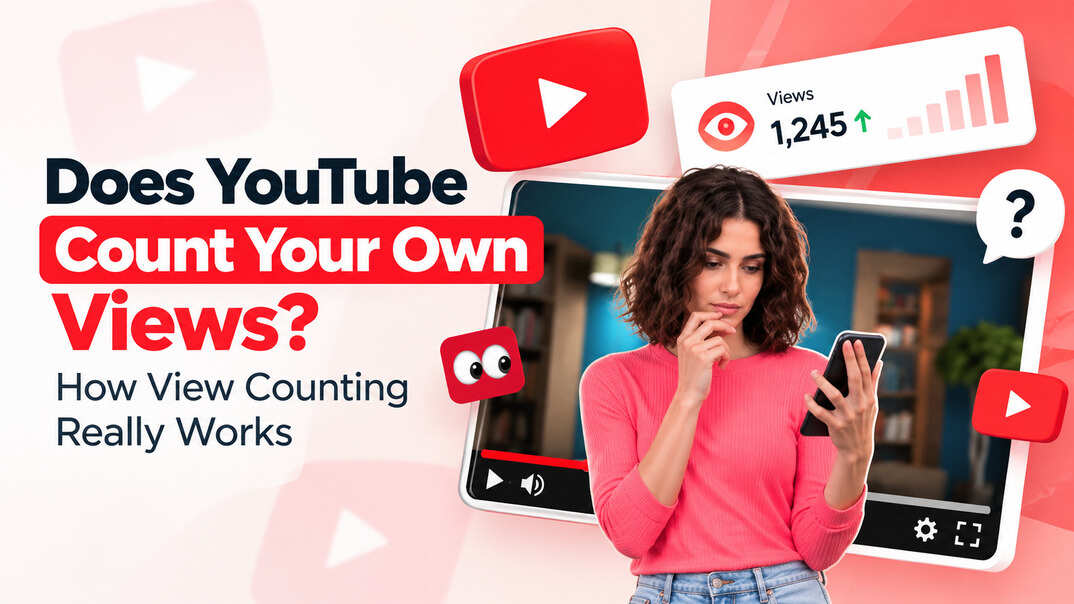


Short answer: yes, YouTube can count your own views. If you open your video and playback starts, that play can register as a public view, just like anyone else's. But here's the catch. Not every playback is guaranteed to stick, and hammering the refresh button won't turn you into a viral sensation. YouTube still validates activity and filters out anything that looks artificial.
So does YouTube count your own views? Yes, with limits. Let's break down what actually happens when you watch your own content, and what changed in 2026.
Does YouTube Count Your Own Views?
When you upload a video and watch it back, YouTube treats that playback like any other. It doesn't flag your account as "the creator" and ignore you. A genuine play from your account can show up in your view count, which is why many creators who want to increase views on YouTube videos often wonder how self-views are handled.
What YouTube does not do is promise that every single play will count. The system looks at patterns. One honest watch-through after publishing looks normal. Opening the same video 40 times in a row from the same device looks like someone trying to game the counter, and that activity gets filtered.
People love to ask for a magic number here. Does the first view count? What about the third? The fifth? YouTube has never published a fixed quota of self-views that will always count. Anyone telling you "YouTube counts exactly three views per account" is guessing.
Think of it this way: YouTube counts views, then checks them. Your own view can survive that check if it looks like a real person watching a video. It probably won't survive if it looks like a bot, even if the "bot" is just you with too much free time.
How Does YouTube Count Views in 2026?
This is where a lot of older articles get it wrong, so pay attention.
Starting August 24, 2026, YouTube changed how public views are counted. Across Shorts, long-form videos, podcasts and live streams, a public view now counts from the moment playback begins. You no longer need someone to sit through 30 seconds for the view to register on the public counter. That old rule is gone for public views.
But YouTube didn't throw away the old metric. It kept it and renamed it. Inside YouTube Analytics, you'll now see engaged views, which reflect the earlier standard of someone actually sticking around. So you get two numbers that tell two different stories:
-
Public views: how many times playback started
-
Engaged views: how many of those turned into meaningful watching
Here's the part creators miss. A public view counting from playback start does not mean YouTube stopped checking. The platform still validates engagement and removes invalid activity. And a public view is not the same thing as a monetization-qualified view. Your headline number can go up while your eligible metrics stay exactly where they were.
If you want the official wording, read YouTube's view-counting update and its engagement metrics guidance.
Does Rewatching Your Own YouTube Video Count as Multiple Views?
Sometimes. It depends on why you're rewatching.
Say you upload a tutorial, notice a weird audio glitch at the four-minute mark, and go back to check it. Then you watch again after re-uploading to make sure the fix worked. That's normal creator behavior. Those plays can register.
Now imagine you sit there refreshing the page every 10 seconds to push the counter from 12 to 50. YouTube's systems are built to spot exactly that. Those views get filtered, and the count may even drop later when validation catches up.
The difference isn't a secret threshold. It's pattern recognition. Natural rewatching has gaps, varied timing, and real viewing. Artificial inflation looks mechanical.
So don't go looking for the "safe limit." There isn't a published one. If you're watching your own video for a real reason, you're fine. If you're watching it to inflate numbers, you're wasting time and possibly flagging your channel.
Read more: Why Are My YouTube Views Not Increasing?
Does YouTube Count Your Own Views on Shorts?
Yes. The August 2026 standard applies to Shorts the same way it applies to long-form content. If you open your own Short and it starts playing, that can count as a public view.
Engaged views remain a separate line in your analytics for Shorts too, so you can see how many people actually watched versus how many just scrolled past as playback kicked in.
One thing to be clear about: Shorts monetization and YouTube Partner Program eligibility don't just look at your headline public-view total. They use their own qualifying metrics. So watching your own Shorts might nudge the public number, but it won't do anything for your eligibility or your earnings.
Read more: How Much Does YouTube Shorts Pay for 1000 Views?
Does Watching Your Own Video Count Toward Watch Time?
This is where creators get their hopes up and then get disappointed.
Public views, watch time, and engaged views are three different metrics. A counted public view does not guarantee that the playback contributes to your eligible public watch hours for monetization. YouTube filters watch time for validity too, and self-generated activity is not a reliable way to build it.
Could a few genuine minutes of you reviewing your upload show up somewhere in your analytics? Possibly. Should you count on it moving the needle toward the 4,000-hour threshold? Absolutely not. If every creator could hit that mark by watching their own videos on loop, the threshold would be meaningless.
If watch hours are your bottleneck, there are smarter paths. Some creators pair longer, better-structured content with a service to increase watch hours on your YouTube video for early traction, while putting their real effort into retention. Either way, your own playback isn't the lever.
Read more: How to Increase Watch Time on YouTube
Does YouTube Count Views From the Same IP Address?
An IP address on its own doesn't decide whether a view is valid. YouTube doesn't publish a formula like "one view per IP per day." What it evaluates is whether the engagement looks legitimate across many signals.
That means a household with four people watching the same video on four devices can generate four real views. It also means switching from Wi-Fi to mobile data to "trick" the system into counting your tenth refresh is pointless. The system is looking at behavior, not just the network you're on.
Don't bother rotating devices, VPNs or accounts to squeeze out extra views. It's not a legitimate strategy and it's exactly the kind of pattern YouTube's filters are designed to catch.
Why Are Your Own Views Not Showing Up?
You watched your video, refreshed YouTube Studio, and the number didn't move. Totally normal.
A few things cause this:
-
Processing delays. View counts don't update in real time. Studio can lag by hours.
-
Validation. YouTube verifies activity before locking it in. Counts can look frozen, then jump, then adjust.
-
Filtering. If activity looked invalid, it gets removed, which is why counts sometimes drop.
Give it time. Check YouTube Studio rather than the public watch page, since Studio tends to show more detailed and more reliable data. If a view disappears, it was likely filtered, not lost to a bug.
Should You Watch Your Own YouTube Videos to Increase Views?
Watch them when you need to. Don't watch them to inflate numbers.
There are great reasons to play your own upload: checking audio levels, reviewing captions, confirming the thumbnail displays correctly, making sure the end screen fires. Do that. It makes your content better.
Playing a video on repeat or refreshing it to manipulate the counter is a different story. Artificial engagement can violate YouTube's policies, and for monetized channels that's a real risk. The views get filtered anyway, so you gain nothing and risk something.
Put that energy into things that work: sharper titles, thumbnails people actually click, and content that keeps viewers watching past the first minute. Social proof helps too. A channel with visible YouTube video likes and more subscribers looks established, which encourages real viewers to stick around and hit subscribe themselves. Just make sure the core of your growth is real people watching real content, because that's what the algorithm rewards.
Read more: How to Get Recommended on YouTube
Final Take
In summary, watching your own YouTube videos for legitimate quality control or editing checks is completely fine and won't harm your channel. However, attempting to artificially inflate your view counts through continuous rewatching or mechanical loops is ineffective, as YouTube's systems filter these out and consider them policy violations.
Frequently Asked Questions
Does YouTube count your own views more than once?
It can, if the rewatches look natural. Repeatedly refreshing to pump the number gets filtered.
Can YouTube count your own views from another account?
A view from a second account can register, but using multiple accounts to inflate counts is still artificial activity and can be filtered or flagged.
Does watching your own video increase subscribers or watch hours?
No on subscribers. On watch hours, your own playback is not a reliable contributor to monetization-eligible watch time.
How long does it take for YouTube views to update?
Anywhere from minutes to a couple of days. Early counts are estimates, and validation can adjust them afterward.
Does YouTube count views from the same IP address?
Multiple real viewers on one IP can all count. Multiple fake plays from different IPs can all be filtered. The IP isn't the deciding factor; the behavior is.
Why did my YouTube view count go down?
When YouTube's system audits view validity, it filters out plays deemed artificial, repeated, or non-engaging, which can cause public view totals to drop retroactively.
Does embedded video playback on external websites count as a view?
Yes, embedded plays count as public views provided the video is played using the embedded YouTube player and meets standard viewing behavior filters.
Do views from private or unlisted videos count toward watch time?
Unlisted or private video views count toward channel analytics, but they do not count toward public watch hours needed for YouTube Partner Program eligibility.
Does watching a YouTube video on mute count as a view?
Yes, muting the audio or video player does not prevent a playback from being counted as a public view.
How many times can one person view a YouTube video and have it count?
There is no public threshold number, but multiple natural views across normal intervals will register, whereas continuous loop watching gets filtered.
Does looping a YouTube video count as multiple views?
Looping a video may count a few initial plays, but YouTube's validation system will quickly detect mechanical replay patterns and filter out subsequent loops.
Can you get banned for watching your own YouTube videos?
Normal self-watching won't get you banned, but attempting artificial view inflation or click-fraud on monetized ads can lead to policy warnings or channel suspension.