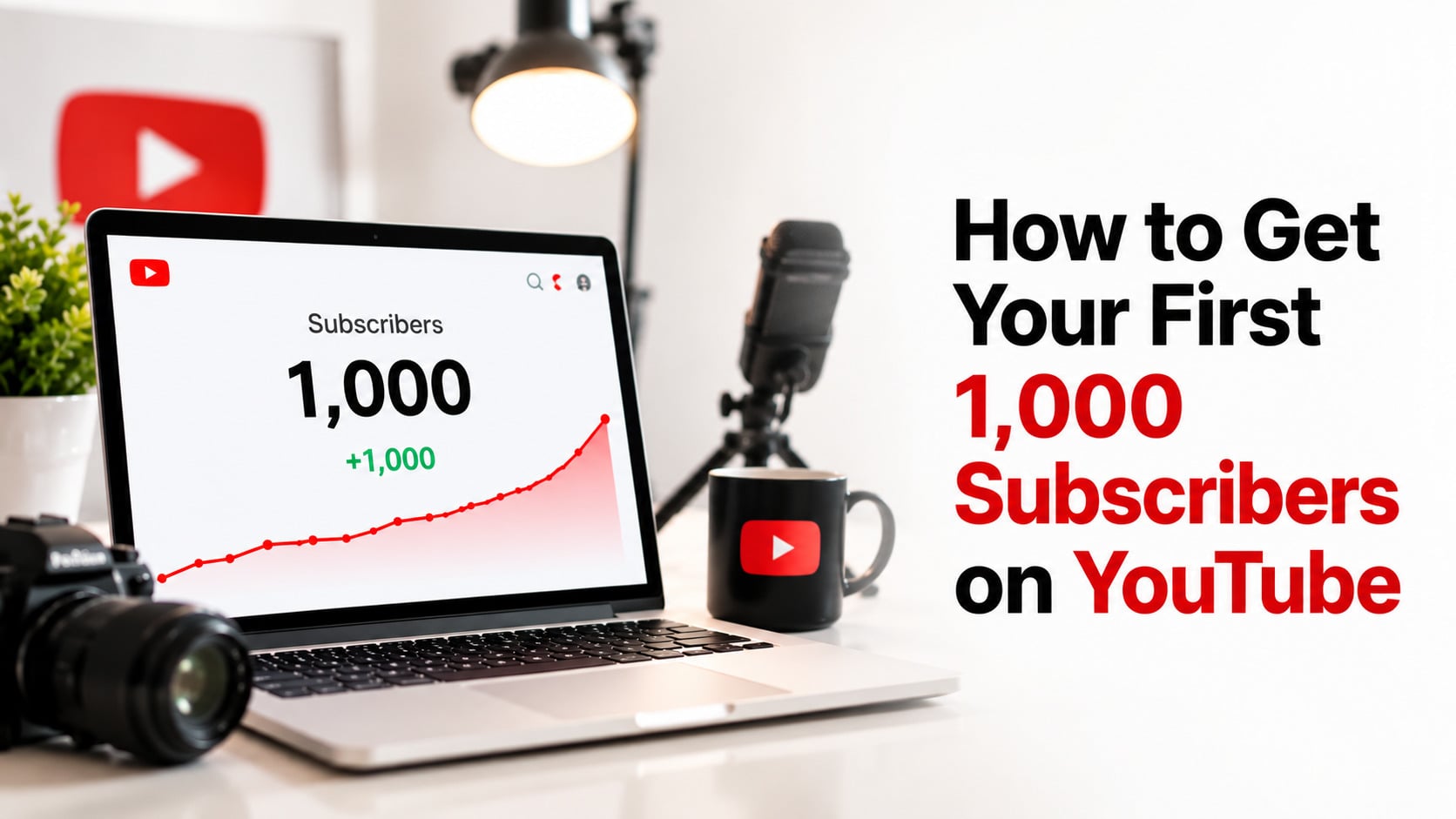



How to get your first 1,000 subscribers on YouTube is the question that separates creators who stick with it from creators who quit in month two. That milestone matters because it's your gateway to the YouTube Partner Program and it's the first real signal that your channel has an actual audience, not just random viewers. I've watched dozens of channels cross this line, and the pattern is always the same: it's not one viral video, it's a repeatable system. In this guide, I'll walk you through exactly how subscribers are actually earned, realistic timelines, and a concrete roadmap to get there.
Why Your First 1,000 Subscribers Are the Hardest
Every channel hits the same wall early on, and it's worth understanding why before you start optimizing anything.
You have no existing audience to notify when you post, so every early video has to earn attention from scratch. YouTube's recommendation system also doesn't know who your content is for yet, since it hasn't collected enough performance data to confidently push your videos to new viewers. On top of that, you're still building trust. Viewers subscribe to creators they believe will keep delivering value, and that trust takes a handful of videos to establish.
This is why the first 1,000 feels so much harder than the next 10,000. Once you clear it, you've usually already solved the core problems of packaging, retention, and content-market fit that made the climb difficult in the first place.
How Many Videos Does It Take to Reach 1,000 Subscribers?
There's no universal number, and any article promising an exact figure is guessing. What we do know from patterns across successful channels is that it typically takes somewhere in the range of 30 to 100 quality uploads, though some channels grow faster and others take longer depending on niche, content format, and consistency.
| Scenario | Typical Videos Needed | Why |
|---|---|---|
| High-demand niche with strong packaging | 20–40 videos | Existing search demand combined with strong CTR accelerates early traction. |
| Average niche with consistent quality | 40–80 videos | YouTube gradually gathers enough data to recommend your content more widely. |
| Competitive or broad niche | 80–150+ videos | Greater competition means it takes longer to stand out and build audience trust. |
Quality matters more than quantity here. Ten well-researched, well-packaged videos will usually outperform fifty rushed uploads with weak retention. Don't chase a video count. Chase consistent improvement in your CTR and retention with every upload.
If you're looking to accelerate your channel's growth with a safe, gradual boost, you can also buy YouTube subscribers to build early social proof and encourage more organic users to follow your content.
How Many Views Do You Need for 1,000 Subscribers?
This is one of the most useful numbers nobody explains clearly. Subscriber conversion rate, meaning the percentage of viewers who subscribe after watching, typically falls somewhere around 1 to 3 percent, though this varies significantly by niche and content type.
Working backward from that range, many channels reach 1,000 subscribers somewhere around 50,000 to 100,000 total accumulated views, though this is a rough guideline rather than a rule. Tutorial and problem-solving content tends to convert at a higher rate than pure entertainment, because viewers who just solved a real problem have a stronger reason to want more from you. If your views are climbing but subscribers aren't following, your conversion rate is the metric to investigate, not your view count.
10 Ways to Get 1,000 YouTube Subscribers Now
1. Choose One Clear Niche
Topical authority isn't optional if you want sustainable subscriber growth. When your channel sticks to one clear topic, YouTube's recommendation system can confidently match your videos to viewers who've shown interest in that exact subject, which improves both impressions and CTR over time.
Audience expectations matter just as much. A subscriber who followed you for personal finance content doesn't want to suddenly see gaming videos in their feed. Niche-jumping confuses both the algorithm and your existing audience, and it's one of the most common reasons channels stall well before 1,000 subscribers.
2. Make Videos People Are Already Searching For
Even the best-produced video struggles if nobody's looking for that topic. Before scripting anything, check what's already ranking, look at YouTube's search suggestions, and see whether similar videos in your niche have meaningful view counts.
Evergreen tutorials and problem-solving content consistently outperform random, trend-chasing uploads for subscriber growth, since they keep pulling in search traffic long after publish day. Every new viewer who finds an old evergreen video is a fresh subscription opportunity, which compounds in a way that trend-based content rarely does.
3. Create Better Thumbnails and Titles
Your packaging, meaning your thumbnail and title together, is what earns the click that starts the entire funnel. A thumbnail needs one clear focal point that reads instantly, and a title needs to pair a specific, relevant promise with genuine curiosity.
Treat these two elements as a single unit rather than separate tasks. A striking thumbnail paired with a flat title wastes the emotional pull you just created, and a strong title paired with a cluttered thumbnail won't get the click in the first place. First impressions on YouTube happen in a fraction of a second, so this is worth testing and refining constantly.
4. Hook Viewers in the First 30 Seconds
Retention starts the moment someone clicks, and the first 30 seconds decide whether they stay. A slow intro, unnecessary greetings, or a delayed payoff on what the thumbnail promised will tank retention before your actual content even starts.
Get to the point fast. Tell viewers clearly what they're about to get, then deliver it without padding. Every retention graph I've reviewed shows the same pattern: channels that front-load value keep significantly more viewers past the opening than channels that ease into their content slowly.
5. Publish Consistently
Consistency builds two things simultaneously: viewer habits and algorithm confidence. When you publish on a predictable schedule, your existing audience learns to expect new content, which improves returning viewer numbers. YouTube also gets a steadier stream of performance data, which helps it understand your channel more reliably.
Pick a schedule you can actually sustain. A realistic weekly upload maintained for six months will outperform an ambitious daily schedule that collapses after three weeks. Momentum lost to inconsistency is hard to rebuild.
6. Turn One Video Into Several Content Pieces
Every long-form video you publish can fuel several smaller pieces of content, and this is one of the most efficient ways to expand your reach without multiplying your production time. Cut a Short from your strongest moment, pull a clip for social media, and post a Community Tab update teasing the topic.
This repurposing does two things. It gives potential subscribers multiple entry points into your channel, since not everyone discovers you through long-form content first. It also reinforces your niche across formats, which strengthens the topical signal YouTube uses to recommend your content.
7. Ask for Subscribers the Right Way
Subscriber requests work best when they're earned, not front-loaded. Asking someone to subscribe before you've delivered any value feels hollow and gets ignored. Asking right after you've solved their problem or delivered a clear payoff feels natural, because you've just demonstrated exactly why subscribing is worth it.
Keep the ask brief and specific. Tell viewers what subscribing gets them, whether that's more tutorials on a specific topic or a consistent weekly series, rather than a generic "don't forget to subscribe" that blends into background noise.
If your goal is to build a larger audience and convert more viewers into subscribers, the first step is to grow your YouTube views with strategies that attract genuine, engaged viewers who are likely to keep watching and subscribe. If you're looking to accelerate your channel's growth with a safe, gradual boost, you can also buy YouTube subscribers to build early social proof and encourage more organic users to follow your content.
8. Build Binge-Watching Sessions
Getting someone to watch a second and third video in one sitting is one of the strongest predictors of whether they'll subscribe. Use end screens to point directly to your best related video, add cards mid-video for relevant follow-ups, and organize your content into playlists that keep autoplay working in your favor.
Structuring your channel around series rather than isolated uploads gives viewers an obvious reason to keep watching. Someone who binges three of your videos in one session is far more likely to subscribe than someone who watches one video and leaves.
9. Learn From YouTube Analytics
Guessing your way to 1,000 subscribers takes far longer than it should. Check these metrics regularly in YouTube Studio:
- CTR: whether your packaging is earning clicks relative to impressions
- Audience Retention: where exactly viewers drop off, and how consistently
- Watch Time: total and average across your recent uploads
- Returning Viewers: whether people are coming back for more
- Subscriber Sources: which specific videos are actually converting viewers into subscribers
That last one is often ignored, but it's one of the most useful reports available. It tells you exactly which content is doing the heavy lifting, which leads directly into the next strategy.
Read more: Best and Most Effective Ways to Increase the Watch Time on YouTube
10. Double Down on Winning Videos
Once you identify which videos are converting well, whether through high CTR, strong retention, or a disproportionate share of new subscribers, make more content like it. This sounds obvious, but a lot of creators keep experimenting broadly instead of building on what's already proven to work.
Create direct follow-ups to your top performers, and build out content clusters around the specific topics that resonate most with your audience. This is often the fastest way to accelerate growth once you have even a small amount of performance data to work from.
Mistakes That Keep Creators Below 1,000 Subscribers
A few recurring patterns show up in channels that stall well before this milestone:
- Switching niches repeatedly, which resets audience trust and algorithm confidence
- Uploading inconsistently, which disrupts both viewer habits and channel momentum
- Weak thumbnails that fail to earn clicks even with decent impressions
- Ignoring analytics and repeating the same mistakes across multiple uploads
- Long, padded introductions that push the hook too far into the video
- Copying trends without adding a genuine, distinct angle
- Buying fake subscribers, which inflates a number without improving any real engagement signal, and can actually hurt how the algorithm evaluates your channel
Fixing even a couple of these consistently tends to unstick channels that have been stuck under 1,000 for a while.
How Long Does It Take to Reach 1,000 Subscribers?
Timelines vary widely, and I'd be doing you a disservice pretending otherwise. Some channels cross 1,000 subscribers in two or three months after a strong early video finds traction. Others take a year or more of steady, consistent uploads before the momentum builds. Niche competitiveness, upload consistency, and content quality all factor in.
Rather than fixating on a specific timeline, focus on your trend. If your CTR, retention, and subscriber conversion are improving video over video, you're on the right track regardless of how many weeks or months it's taking.
Your 30, 90, and 180 Day Action Plan
- First 30 days: Lock in one clear niche, publish your first 4 to 8 videos, and focus entirely on packaging and a strong first 30 seconds. Don't worry about subscriber count yet. Focus on learning what resonates.
- Next 90 days: Review your analytics weekly. Identify your best-performing video and create at least two follow-ups to it. Start repurposing long-form content into Shorts and Community posts to widen your entry points.
- By 6 months: You should have 25 to 50+ uploads and a clear sense of which topics convert best. Double down on those clusters, tighten your subscriber asks around your strongest content, and keep refining retention based on your analytics patterns.
Reaching 1,000 Is a System, Not a Lottery Ticket
The creators who reach this milestone fastest aren't the ones waiting for a lucky viral hit. They're the ones treating every upload as a chance to improve packaging, retention, and content-market fit, then doubling down on whatever the data shows is working. Stay consistent, watch your analytics honestly, and trust that subscribers follow naturally once your content consistently earns attention and delivers on its promise.
Final Take
Reaching your first 1,000 subscribers isn't about chasing viral luck, it's about building a sustainable system. By focusing on consistent quality, refining your packaging based on analytics, and delivering genuine value in every video, you turn the platform's recommendation system into an asset rather than a hurdle. Success is a marathon, not a sprint; stay disciplined, learn from your data, and remember that every view is an opportunity to earn trust.
Frequently Asked Questions
How do I get my first 1,000 subscribers on YouTube?
Focus on the full funnel: choose one niche, create content people are already searching for, optimize your thumbnails and titles to earn clicks, hook viewers fast, and build binge-watching sessions through playlists and end screens. Subscribers are the result of strong performance across all of these, not a single tactic.
How long does it take to get 1,000 subscribers on YouTube?
Timelines vary widely by niche and consistency, ranging from a few months to over a year. What matters more than the exact timeline is whether your CTR, retention, and subscriber conversion rate are trending upward with each upload.
How many views do I need for 1,000 subscribers?
Many channels reach 1,000 subscribers somewhere around 50,000 to 100,000 total views, based on a typical subscriber conversion rate of roughly 1 to 3 percent, though this varies by niche and content type.
Can I get 1,000 subscribers for free?
Yes, and it's the only sustainable path. Organic growth through strong packaging, retention, and consistent value costs time rather than money, and it builds real engagement that buying subscribers can never replicate.
How often should I upload to grow faster?
Consistency at a sustainable pace matters more than sheer frequency. A realistic weekly schedule maintained for months will typically outperform an aggressive daily schedule that burns out after a few weeks.
Can YouTube Shorts help me reach 1,000 subscribers?
Yes. Shorts can introduce your channel to a much wider audience than long-form content alone, and directing engaged Shorts viewers toward your long-form videos through your channel page and pinned comments can convert some of that reach into subscribers.
Should I ask viewers to subscribe?
Yes, but timing matters. Ask after you've delivered clear value in the video, not before, and keep the request specific about what subscribing gets them rather than a generic reminder.
Can small channels grow quickly?
Yes. YouTube's recommendation system tests videos based on how they perform with an initial audience, not on subscriber count, so a small channel with strong CTR and retention can grow just as fast as an established one.
Is buying subscribers worth it?
No. Bought subscribers don't watch, engage, or convert, and a mismatch between subscriber count and actual engagement can hurt how the algorithm evaluates your channel's health going forward.
Does YouTube promote small channels?
Yes. Recommendations are based on how a video performs during its initial testing phase, not on how large the channel already is, which means small channels with strong performance signals get pushed just like larger ones.
Is 1,000 subscribers enough to make money?
It's the minimum subscriber requirement to apply for the YouTube Partner Program alongside the watch hour or Shorts views threshold, so it's an important milestone toward monetization, though actual earnings depend on additional factors like niche, ad rates, and engagement.
What type of videos gain subscribers the fastest?
Evergreen tutorials and problem-solving content tend to convert viewers into subscribers at a higher rate than pure entertainment, since viewers who've just gained real value have a stronger reason to want more from your channel.